
Most Managers Don't Have a Time Problem. They Have a Priorities Problem.
You start the week with a clear plan. By Tuesday, it is gone.
Every day, someone else's urgency becomes yours: messages, meetings, requests, fires to put out. You are moving fast, but somehow never forward. And at the end of the week, you look back and realise the things that actually matter, the ones that would move the needle for your team and your organisation...never got touched.
You tell yourself that you just need more time. But that is not the problem.
Most managers don't have a time problem. They have a priorities problem.
When everything feels urgent, nothing gets the attention it deserves. You end up reacting to whoever shouts loudest, compensating for your team's gaps instead of developing them, and carrying tasks that were never really yours to carry.
The result? You are exhausted. Your team has more to give than you are letting them. And the work that would actually grow your people, your team, and your own leadership keeps getting pushed to next week.
This is the priorities trap, and there is a framework that fixes it.
The Eisenhower Matrix
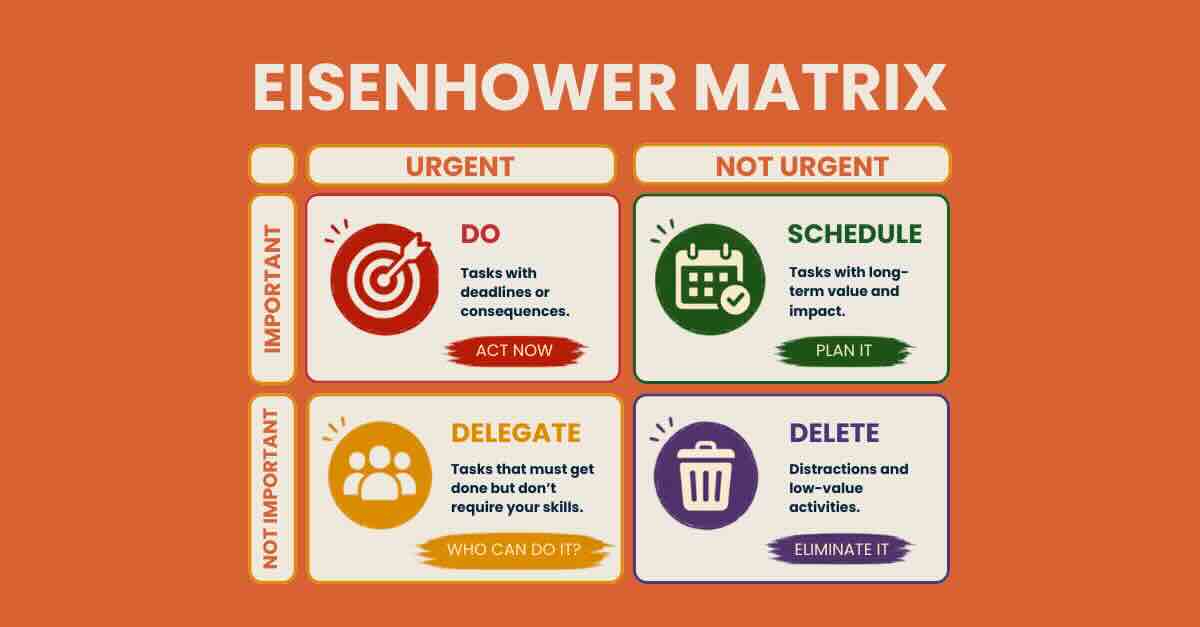
One of the most practical tools for managers trying to get out of their own way is the Eisenhower Matrix. It organises every task across two axes: urgency and importance, giving you four quadrants with a clear action each.
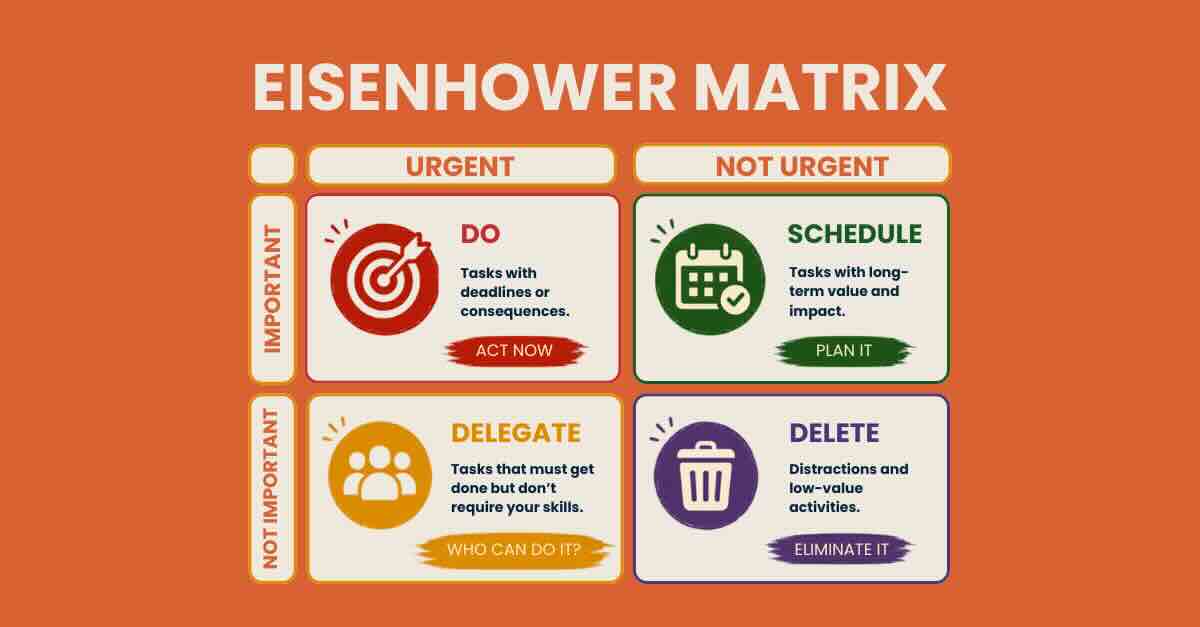
- Quadrant 1: Important and Urgent >> Do it
Real deadlines, real consequences. A client crisis. A decision that cannot wait. A team member who needs immediate support. These tasks deserve your full attention right now, and they should get it.
The trap is spending most of your time here. When Quadrant 1 is constantly overflowing, it is usually a signal: not enough planning, not enough delegation, and not enough investment in your team's capability. A strong, well-developed team reduces the volume of tasks that land here in the first place.
- Quadrant 2: Important but Not Urgent >> Schedule it
These tasks never feel urgent, so they keep getting pushed. But this is where real leadership happens. Every hour you invest here pays back in fewer crises, a more capable team, and a workload that gradually becomes more manageable rather than more overwhelming.
Most managers who feel constantly behind are not spending enough time in Quadrant 2. The irony is that Quadrant 2 is the very place that would fix that feeling.
If you want to spend less time in Quadrant 1 (Important & urgent), invest more in Quadrant 2 (Important but not urgent)
- Quadrant 3: Urgent but Not Important >> Delegate it
This is the delegation goldmine that most managers overlook. Tasks that feel pressing but do not actually require your specific skills, judgment, or authority.
Routine reports, scheduling, coordination emails, and status updates. Operational tasks that need to get done, but could absolutely be owned by someone on your team.
The key question for every Quadrant 3 task is simply: who can do this?
Not who will do it exactly the way you would. Not who is most convenient. But who has, or could develop, the capability to own this? When you delegate Quadrant 3 tasks intentionally, you free up your own time for Quadrant 2 work and create real growth opportunities for your people.
- Quadrant 4: Not Important and Not Urgent >> Delete it
Distractions dressed up as tasks. Unnecessary meetings you attend out of habit. Reports nobody reads. Low-value admin that fills time without creating output. Anything that makes you feel busy without making you effective.
Be ruthless here. Every hour spent in Quadrant 4 is an hour taken from Quadrant 2. Eliminating these is not laziness. It is one of the most important decisions a manager can make.
How to Use This With Your Team
The Eisenhower Matrix is not just a personal tool. Used well, it becomes a shared language for how your team makes decisions about time and effort.
Try this in your next team meeting. Put your current tasks and projects on the table and map them together.
Where does each one sit? Who is best placed to own each quadrant?
You will often find that tasks sitting on your plate belong firmly in someone else's zone, and that your team has far more capacity than you have been giving them credit for.
This exercise also opens a powerful coaching conversation. When team members begin to map their own work through this lens, they develop a sharper sense of what actually matters, and they stop waiting for you to tell them what to do next. That is when a team starts to develop real capability and confidence.
A deadline with no room for growth trains your team to wait for you instead of figuring things out themselves.
When you do delegate, set realistic deadlines that include buffer time for feedback and adjustment. Help your team member understand not just what to do but why it matters and what success looks like.
Stay curious rather than critical when they approach it differently than you would. Different approaches build resilience into your team and reduce their dependence on you for every decision.
How to Apply This to Your Own Life
The priorities problem does not stop at work. Most managers carry it home, too.
Look at your personal time with the same honesty you would apply to your task list. Which commitments are genuinely important to your wellbeing, your relationships, your growth?
Which ones feel urgent but could be simplified, outsourced, or handed to someone else? And which ones keep appearing on your mental to-do list out of guilt or habit rather than genuine value?
Protecting your Quadrant 2 time personally is just as important as protecting it professionally. For me, that means guarding the first hours of my morning for creating, thinking, and building. Everything else waits. Not because the other things do not matter, but because I know that if I do not protect that time, someone else's urgency will claim it.
Your calendar is a reflection of your priorities. Who owns your best hours, you or everyone else?
The Practice This Week
Write down everything on your plate right now. Every task, every commitment, every thing takes up mental space. Then map each one to a quadrant honestly, not optimistically.
Then ask yourself three questions.
- What am I holding in Quadrant 3 that I could hand to someone on my team this week, with a proper brief and a check-in point?
- What Quadrant 2 investment have I been postponing that would make the biggest difference to my team's capability?
- And what is sitting in Quadrant 4 that I could simply stop doing without anyone noticing?
Pick one action from each question. Do that before anything else.
For Your Bookshelf
The One Minute Manager Meets the Monkey by Ken Blanchard. A short, sharp read on why managers end up carrying everyone else's problems and how to stop. The monkey metaphor will change how you see every conversation with your team.
Multipliers by Liz Wiseman. The difference between leaders who drain the intelligence around them and those who amplify it. A genuinely challenging read for anyone who considers themselves a high performer.
Turn the Ship Around by L. David Marquet. A real story of a leader who transformed a culture of waiting for instructions into one of radical ownership. One of the best leadership books of the last two decades.
Closing Thought
Getting your priorities right is not a productivity hack. It is a leadership decision.
When you are clear about what deserves your attention, you become more useful to your team, not because you are doing more, but because you are finally doing the right things.
You create space for your people to grow. You invest in the work that compounds. And you stop arriving at the end of every week, wondering where the time went.
The matrix does not manage your priorities for you. You do.
But it gives you the clarity to make better choices, more often, with less guilt about the things you are not doing.
Related articles
Stop managing people. Start developing them.
Management is about control. Development is about growth. Your goal as a leader is not to make yourself indispensable. It is to make yourself unnecessary
How Appreciation Can Improve Your Team's Performance
What if the culture you want already exists in your team? You just haven't surfaced it yet.

The Real Reason Your Feedback Isn't Landing & How to Fix It
The problem with your feedback isn't your intention. It's your default style. Here's what to do about it.

Stay connected. Get insights, tools, and reflections delivered to your inbox.
Subscribed!
Something went wrong. Please try again.