
How Appreciation Can Improve Your Team's Performance
There is a moment most leaders know but rarely talk about.
You walk into a team meeting, and the air is heavy before anyone says a word. Someone is quietly resentful. Someone else is performing fine but barely present. Two people avoid each other's eye contact across the table. And underneath all of it, a slow accumulation of unspoken frustration: who dropped the ball, who did not pull their weight, who always gets away with it.
This is a blaming culture. And it does not always announce itself loudly. Most of the time, it seeps in quietly, especially in teams built from people of different backgrounds, different communication styles, different values, and different ideas of what "doing a good job" even means.
In a previous article on identity and wearing multiple hats, I wrote about how the tension we feel inside ourselves often mirrors the tension we experience with others. The same is true in teams. When people do not feel seen as whole human beings, they default to self-protection. And self-protection, at scale, becomes blame.
The harder truth? Most leaders respond by trying to fix what is broken. Performance reviews. New processes. Clearer KPIs. And while those tools have their place, they rarely touch the root of the problem.
Because the root is not performance. It is the way people see each other.
"Organisations and teams move in the direction of what they study and talk about most. If your team spends most of its energy diagnosing problems, problems become the dominant reality."
When Companies Stopped Asking "What's Wrong?"
In the early 2000s, Roadway Express, one of America's largest freight companies, was in trouble. Trust between unionised employees and management had collapsed, blame was the default language, and productivity was suffering.
They invited everyone: truck drivers, union leaders, HR teams, executives, and customers into a three-day Appreciative Inquiry summit. Over 200 people in one room. And instead of asking "What is broken and who is responsible?", they asked one simple question: What is already working, and how do we build more of that?
At the start, union members physically turned their backs to the CEO. But by focusing on positive contributions and inviting every voice into designing solutions, trust slowly began to build. Over three years, the company held 65 summits, saw a significant rise in stock value, and built a culture of collaboration that had not existed before.
The hospitality industry offers an equally instructive example. During my MBA, Professor Kiran shared a case that stayed with me. A hospitality company preparing to open a new hotel sent its team out to visit competitors, not to critique them, but to experience them as a genuine guest would. The brief was simple: notice what you love. They came back with a list of the best moments they had encountered and used that as the foundation for their own guest experience.
"The question was not 'how do we beat them?' It was 'what can we learn from what is working out there?'
That reframe, from threat to teacher, is what Appreciative Inquiry makes possible."
What Appreciative Inquiry Actually Is
Appreciative Inquiry was developed by Dr David Cooperrider at Case Western Reserve University. At its core, it rests on one idea: organisations and teams move in the direction of what they study and talk about most.
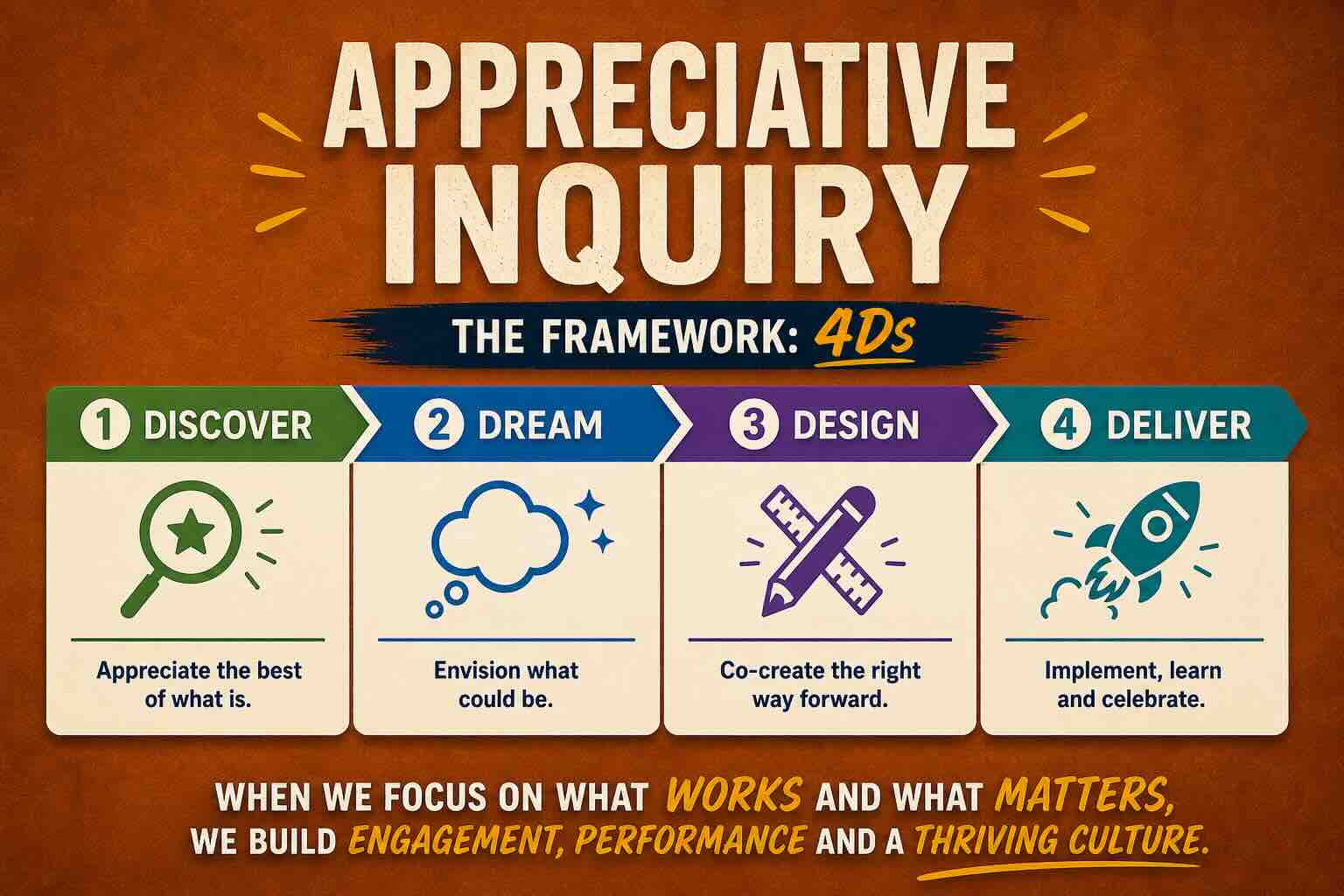
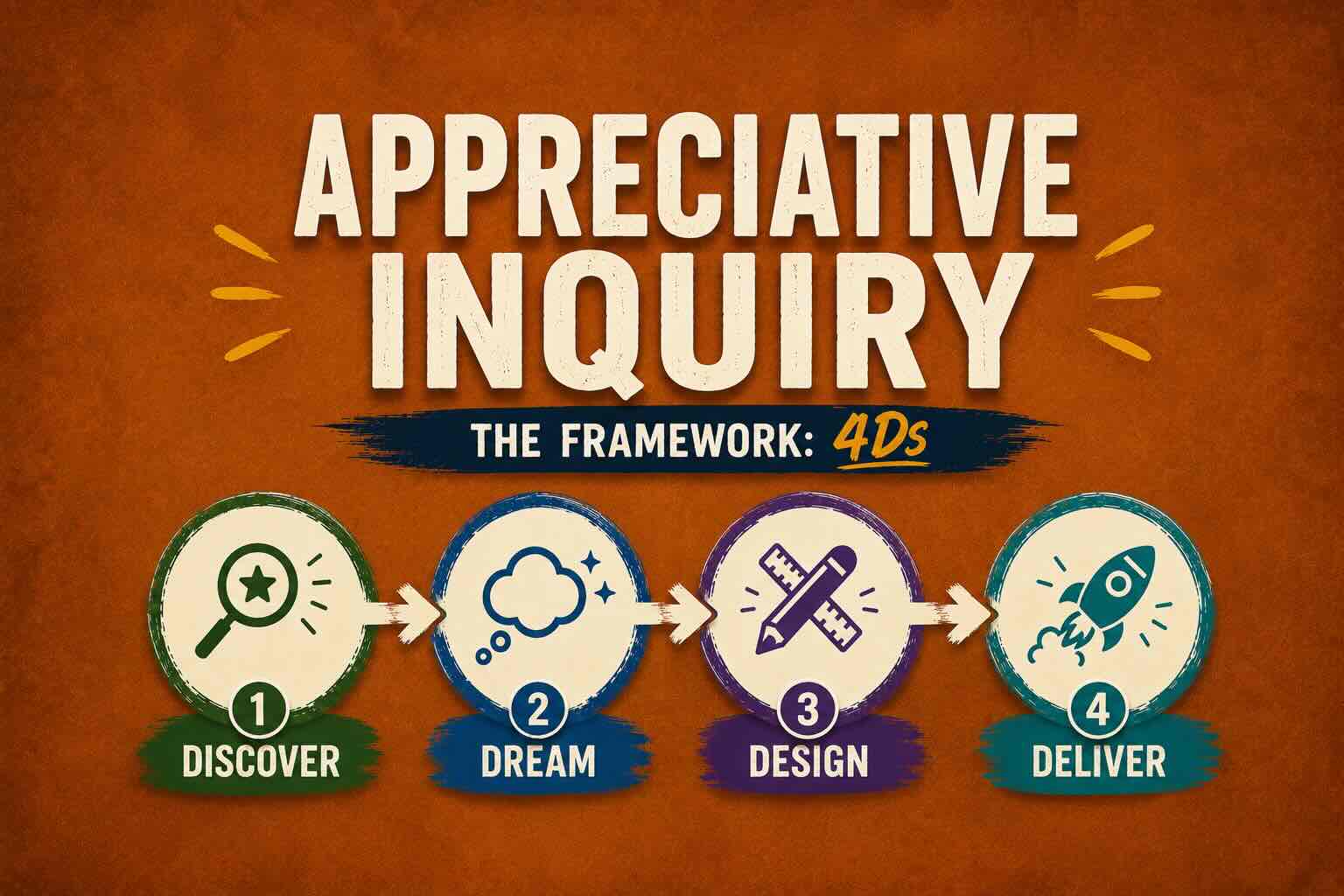
The framework moves through four stages, known as the 4Ds:
Discover: What is working well? What are we proud of? When have we felt most alive as a team?
Dream: What could we become if we did more of what already works?
Design: What do we commit to doing differently?
Deliver: How do we put that into practice, starting now?
It is not about ignoring problems. It is about choosing a different entry point, one that activates energy instead of draining it.
And here is where it connects to personal leadership. In a recent article on why feedback does not land, I explored how communication breaks down not because of what we say, but because of how the other person receives it. Appreciative Inquiry works on the same principle. When people feel seen and valued first, they are far more open to growing.
How I Brought It Into My Own Team
Two weeks into opening OTA Playhouse, I ran a simple version of this. Each person wrote down one thing they had learned during their first month working here, a lesson, a moment, or something they picked up from a colleague. Then we swapped notes. Someone else read yours out loud.
What happened next surprised even me. When your words are read by someone else, they land differently both for the listener and for the person who wrote them. People started hearing things about their colleagues they had never known. The quiet team member who rarely spoke up had written something profound. The one who always seemed confident shared something unexpectedly vulnerable. And in that moment, something shifted in how they saw each other.
This was not just a warm-up exercise. For a team that had been carrying unspoken tension, it became the turning point. When you understand where someone has come from and what they value, it is very hard to stay in judgment of them. Appreciative Inquiry did not solve the conflict directly. It changed the lens through which people saw each other and that changed everything.
How to Apply This in Your Team
You do not need a three-day summit. Here is how to start this week.
In your next team meeting. Ask each person: "Think of a time you felt most proud or most connected to your work. What was happening?" Swap notes, read them aloud, and close with one thing the team wants to do more of. Four steps. Under 20 minutes.
In your one-on-ones. Instead of opening with what is stuck, try: "What has felt most energising for you lately? What is one thing you did recently that you felt genuinely good at?" You will learn more in five minutes than a performance review tells you in an hour.
When navigating conflict. Sit with each person separately and ask: "What do you genuinely appreciate about the way your colleague works?" Then bring them together and have each share what the other said. It is hard to stay in blame when you are being appreciated out loud.
"When people feel seen and valued first, they are far more open to growing. Appreciative Inquiry changes the conditions of the conversation before a single word of feedback is given."
And Now, an Invitation for You
Everything above is about your team. But I want to turn it inward for a moment.
Because the same culture you are trying to build in your team, you have to build in yourself first. Most leaders are exceptional at identifying their own gaps. But that kind of relentless self-critique can become its own blaming culture, just turned inward.
So I want to ask you the same question I asked my team:
When did you feel most alive as a leader? What were you doing? What did it bring out in you?
Sit with that. Write it down. Notice what it reveals about who you are at your best. That is Appreciative Inquiry applied to personal leadership. And in my experience, it is where the real transformation begins.
"The seeds of the culture you want are almost always already there, in the moments people felt proud, in the values they carry quietly, in the care they show when no one is watching."
Related articles
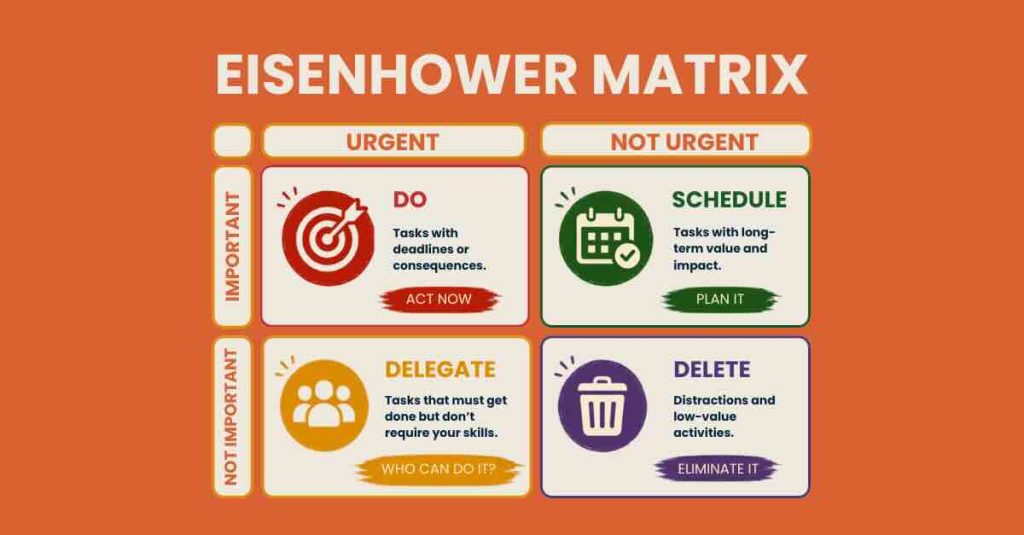
Most Managers Don't Have a Time Problem. They Have a Priorities Problem.
Every day, someone else's urgency becomes yours: messages, meetings, requests, fires to put out. You are moving fast, but somehow never forward. And at the end of the week, you look back and realise the things that actually matter, the ones that would move the needle for your team and your organisation...never got touched.
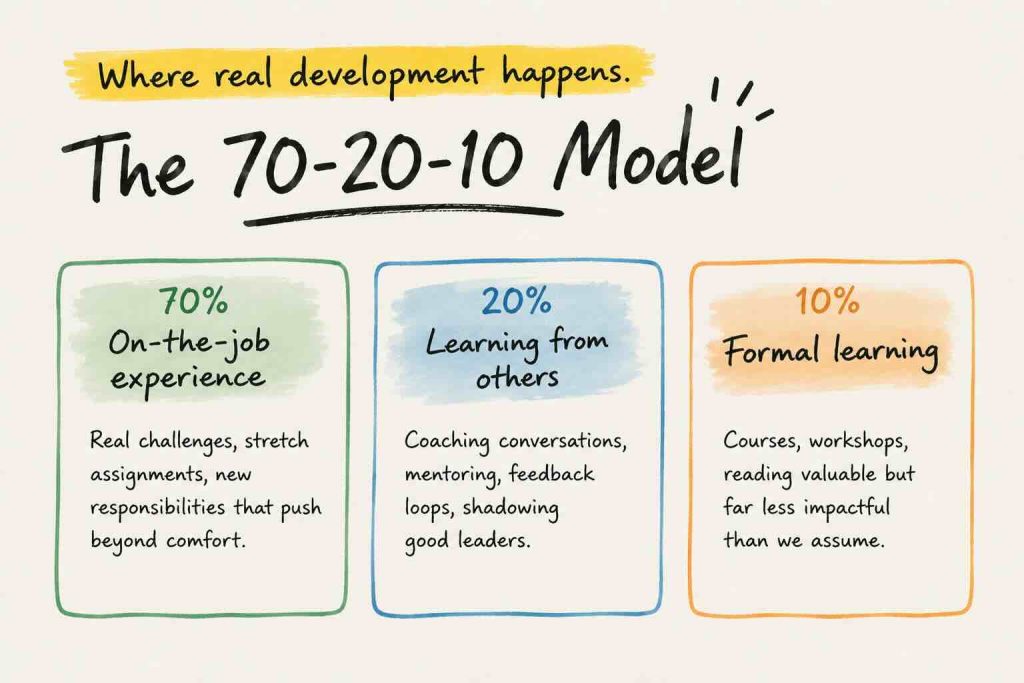
Stop managing people. Start developing them.
Management is about control. Development is about growth. Your goal as a leader is not to make yourself indispensable. It is to make yourself unnecessary

The Real Reason Your Feedback Isn't Landing & How to Fix It
The problem with your feedback isn't your intention. It's your default style. Here's what to do about it.

Stay connected. Get insights, tools, and reflections delivered to your inbox.
Subscribed!
Something went wrong. Please try again.