
Stop managing people. Start developing them.
The word "management" might be holding you and your team back more than you realise.
A few weeks ago, I sat down with a manager for her two-month probation assessment. As I walked in, I could see it on her face: that particular mix of excitement and quiet anxiety that comes when you are waiting to be judged. She was eager, prepared, and ready to hear the verdict on her performance.
What happened next was not what she expected.
Instead of opening with KPIs met or missed, I turned the conversation around. I asked her to give her own assessment and to say whether she was enjoying her work. I asked what skills she wanted to develop and what we as a company could do to improve her work satisfaction and make her day-to-day more effective.
Her whole demeanour shifted. The anxious, performance-review posture melted into something else entirely: surprise, then openness, then genuine engagement. We ended up having one of the most honest, forward-looking conversations I have had in a professional setting.
That moment crystallised something I had been thinking about for a while: we have been using the wrong word, and the word we use shapes everything about how we lead.
The problem with "management".
Management is about control. Development is about growth.
"People management" puts the leader at the centre, in control of tasks, outputs, and behaviour. It frames your team members as variables to be optimised, problems to be solved, and risks to be mitigated. And when that is your mental model, it changes how you show up in every interaction.
You check in more than you need to. You answer questions instead of asking them. You correct instead of coaching. And slowly, without meaning to, you build a team that depends on you for everything, because that is exactly what the management mindset trains them to do.
Here is the leadership truth that took me time to internalise: competent, trusted people manage themselves fully. They do not need to be controlled. They need to be developed, given the skills, the confidence, and the autonomy to do their best work.
When you invest in someone's growth, you are not just making them better at their job. You are building the kind of person who does not need to be managed at all.
"Your goal as a leader is not to make yourself indispensable. It is to make yourself unnecessary."
The small shifts that add up
The difference between managing and developing rarely shows up in big strategy moments. It lives in the small, daily interactions: the way you handle a question, run a check-in, or approach a performance conversation.
Shift 1: From answering to coaching
When someone comes to you with a problem, the managing instinct is to solve it. Fast, efficient, done. But every time you answer instead of coaching, you reinforce dependence.
Try this instead: "What options have you already considered? What would you do if I were not available?" Most of the time, they already know the answer. Your job is to help them trust it.
Shift 2: From performance review to development conversation
The traditional probation review is a verdict. The development conversation is a dialogue. Instead of "Here is how you performed against KPIs..."
Try this instead: "How do you feel you have been doing? What has been energising? What feels hard? What do you want to get better at?"
The result: You get far more honest information, and your team member leaves feeling invested in, not evaluated.
Shift 3: From task delegation to stretch assignments
Delegation is giving someone work. Development is giving someone work that grows them. Before you assign a task, ask: Is there someone on my team for whom this would be a stretch? Could this be a development opportunity rather than just a to-do?
The distinction matters: one clears your plate; the other builds your team.
Framework 1
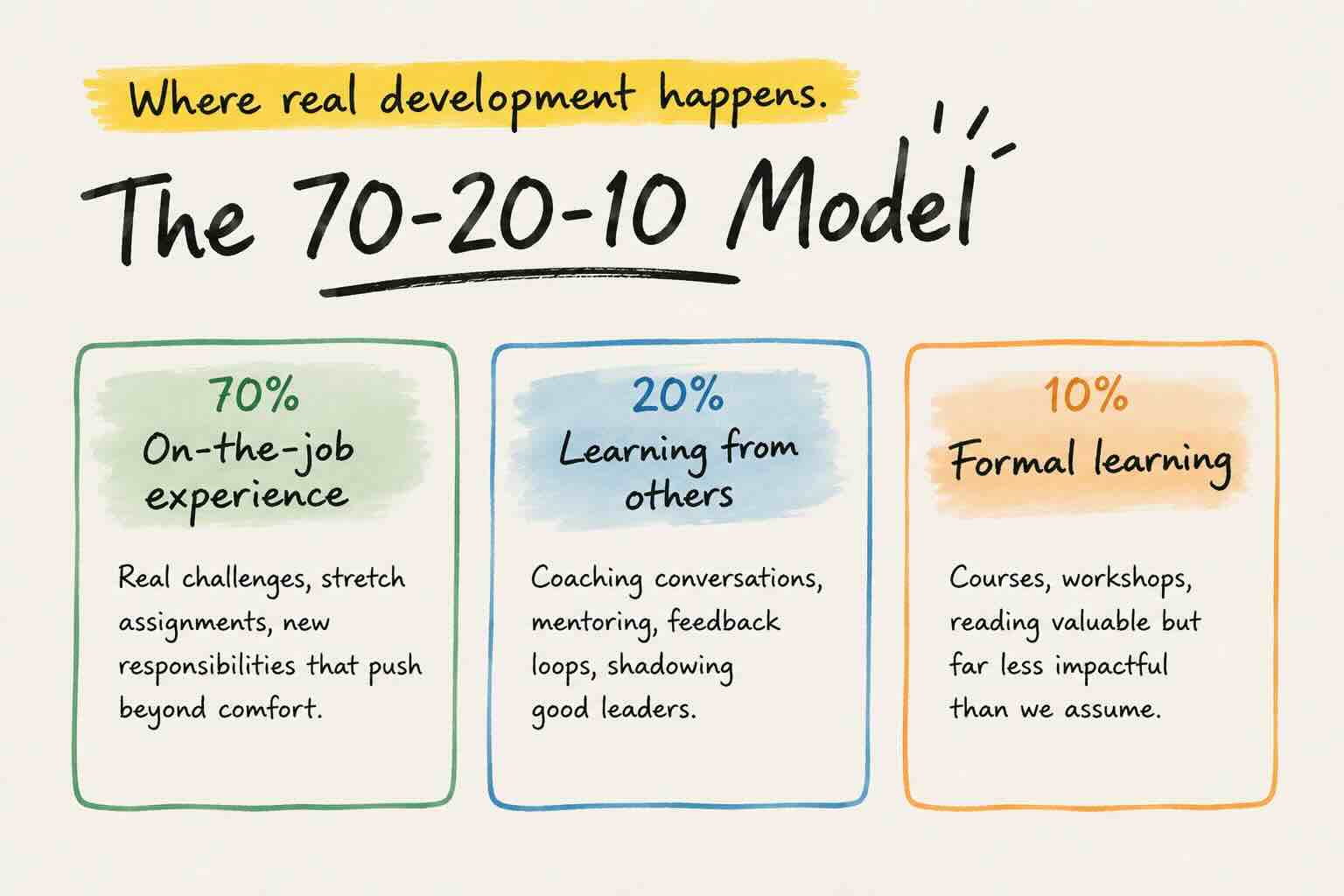
The 70-20-10 model: where development actually happens
Most organisations spend the majority of their L&D budgets on formal training: courses, workshops, and certifications. But research tells a very different story about how adults actually develop at work.
Originally developed in the 1980s by researchers Morgan McCall, Michael Lombardo and Robert Eichinger at the Centre for Creative Leadership in North Carolina, this model came out of a study of over 200 successful executives across six major corporations.
Their finding was simple but important: the vast majority of meaningful professional development does not happen in a classroom. It happens through real work, real relationships, and real feedback.
The model was later popularised through the book The Lessons of Experience and has since been adopted as the foundation of talent development strategy at organisations including Goldman Sachs, Microsoft, Bank of America, Mars and Maersk.
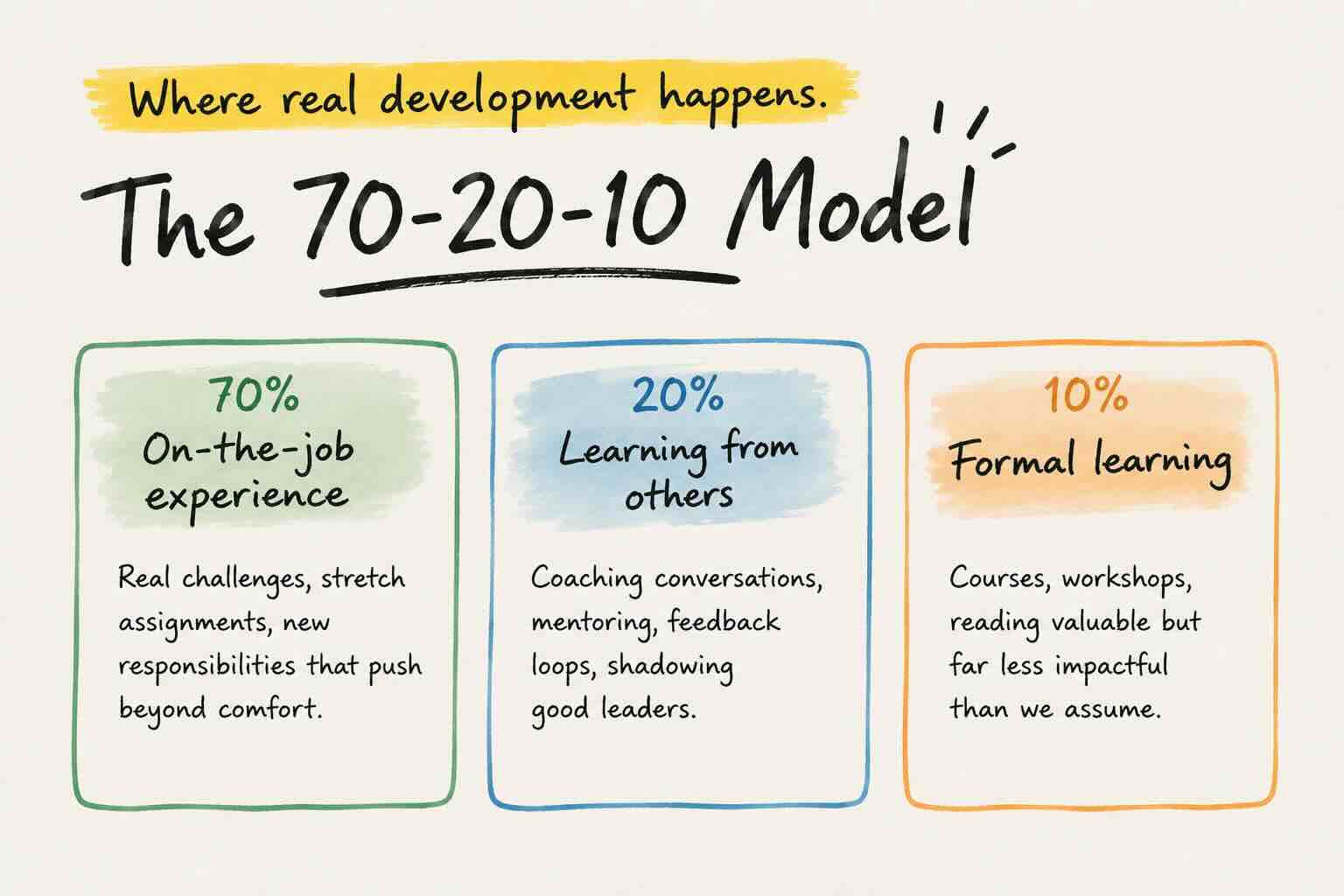
It is worth noting that the creators themselves stress this is a guiding principle, not a rigid formula. The precise ratios matter less than the mindset shift: most development happens through real work and real relationships, not training programmes.
As a leader, your leverage is almost entirely in the 70 and the 20. The assignments you give. The conversations you have. The feedback you offer, and how you offer it.
Try this this week
Pick one person on your team. Ask them: "What is one skill you would love to develop this quarter?" Then find one real task or project, not a training course, that stretches them in that direction. That is development in action.
Framework 2
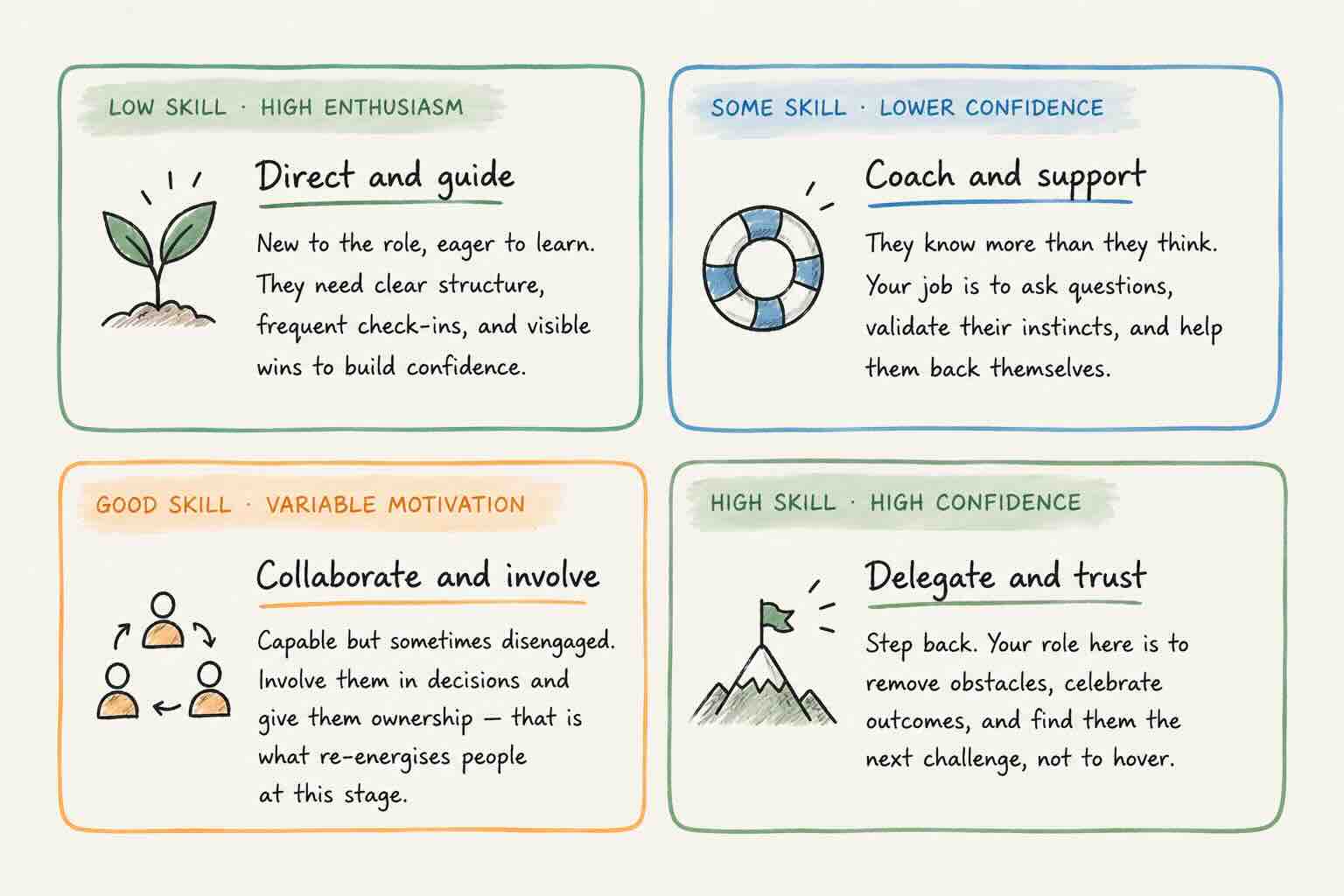
Situational leadership. Meeting people where they are
Not everyone on your team needs the same kind of development. Blanchard's Situational Leadership model is a useful lens: your leadership style should adapt based on each person's current competency and confidence level in a given task.
The foundation
None of this works without trust
Development requires vulnerability from both sides. For your team member to admit a gap, ask for help, or take a risk on a stretch assignment, they need to trust that failure will not be held against them. That mistakes are data, not verdicts.
That trust is built in small, consistent moments when you give credit publicly. When you back someone's call, even when it is uncertain. When you have the hard conversation privately rather than as a public correction. When you show up to a 1:1 with genuine curiosity rather than a checklist.
And there is a reciprocal side to it: as a leader, you have to be willing to show your own development journey. The moment you pretend to have all the answers, you make it unsafe for anyone else not to have them. Vulnerability at the top gives permission for vulnerability everywhere.
When trust is real, and competence is growing, something shifts. Your team stops waiting for direction and starts generating it. They stop managing up and start managing themselves. And your role evolves from controller to architect, designing the conditions for people to do their very best work.
The takeaways
- The word matters. "Management" centres control. "Development" centres growth. Choose your lens deliberately.
- Competent people manage themselves. Your job is to build that competency, not to compensate for its absence.
- 70% of development happens through real work. The assignments you give are your most powerful development tool.
- Adapt your style to where each person actually is, not where you want them to be.
- Trust is the prerequisite. Without it, development conversations stay surface-level.
- Start this week: turn your next performance check-in into a development conversation. Ask first. Listen fully. Then decide.
Related articles
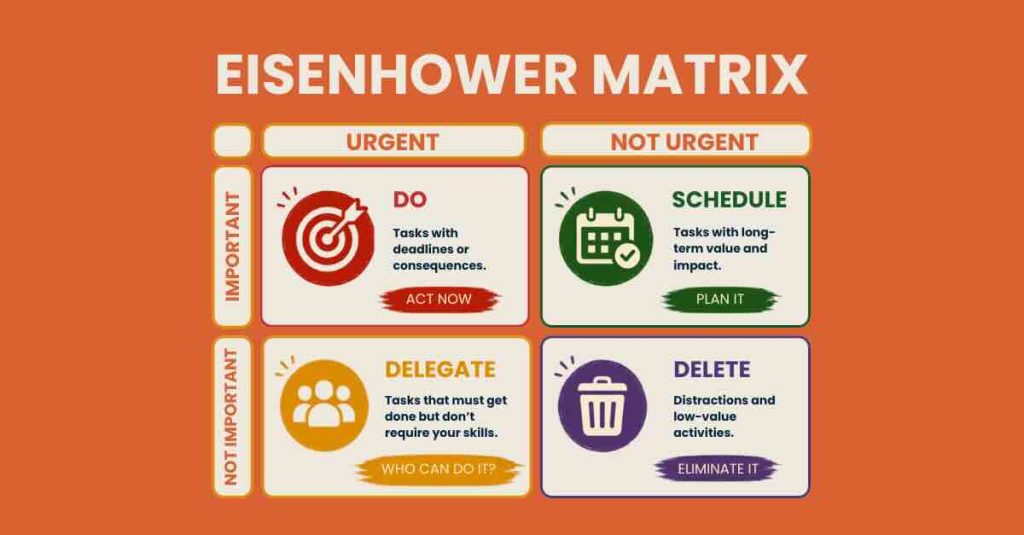
Most Managers Don't Have a Time Problem. They Have a Priorities Problem.
Every day, someone else's urgency becomes yours: messages, meetings, requests, fires to put out. You are moving fast, but somehow never forward. And at the end of the week, you look back and realise the things that actually matter, the ones that would move the needle for your team and your organisation...never got touched.
How Appreciation Can Improve Your Team's Performance
What if the culture you want already exists in your team? You just haven't surfaced it yet.

The Real Reason Your Feedback Isn't Landing & How to Fix It
The problem with your feedback isn't your intention. It's your default style. Here's what to do about it.

Stay connected. Get insights, tools, and reflections delivered to your inbox.
Subscribed!
Something went wrong. Please try again.